Principal product consultant · Neo Innovation, Singapore · 2014–15
Neo didn't employ product managers. Teams were principal designers and principal engineers, and the designers carried product — the roadmap, the prioritisation, the calls about what shipped and what got cut. It's where the way I still work came from: design and product as one job rather than two people negotiating across a handover.
The method had a name and an address. Jeff Gothelf and Josh Seiden, who wrote Lean UX, were both principals at Neo — the book's own author biographies list them there. They interviewed me for the Singapore role. So the Lean UX we practised on client work wasn't picked up from a conference talk; it was the house method, taught by the people who wrote it down. Both have since written recommendations for me.
The three-day inception
Early-stage founders came to us to find out whether they had a product. Over two or three days in a room we mapped the whole thing: who it was for, where the value actually sat, where the friction would appear, and what would have to be true for any of it to work.
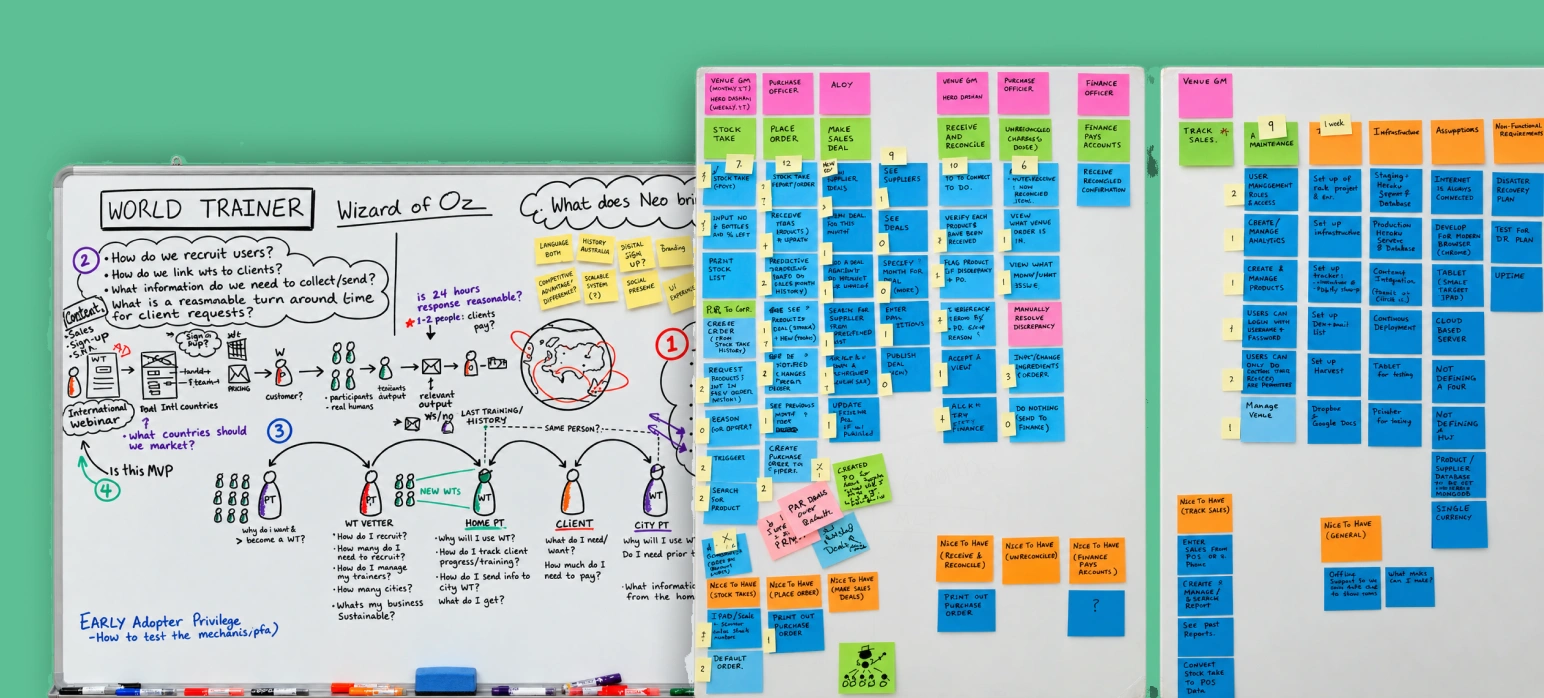
The method was a hybrid of user story mapping and service mapping, run in person on walls in Post-its and Sharpie. Nothing went digital until the wall was right. I was the principal facilitator.
The running order barely changed between clients:
- Lean canvas
- Roles and personas — motivations, anxieties, causality, attributes
- What does success look like — empathy map, word association
- Must-have needs
- Map the ideal flow, sketch the process screens
- Storymap built from the flow
- Deadlines and milestones
- Style guide — UI, progressive enhancement, mobile
That last item is the one worth noticing. Progressive enhancement wasn't a decision made on one project; it was a standing agenda item on every scope we ran.
Plenty of founders didn't come back for a second phase. Three days was enough to establish that the business underneath the idea wasn't there — the cheapest possible place to find that out, and exactly what the format was for. Around thirty of these ran over two years.
Ministry of Manpower
Singapore's first agile-delivered government software. Three consultancies, up to thirty people in one room, built HTML-first with zero JavaScript and progressive enhancement only where it earned its place. Best UI / UX Design, GovInsider Innovation Awards 2016.
Digify
A secure document-sharing product heading into an SXSW awards night with a signup and sharing flow that wasn't ready for the attention.
Customer research and corridor testing drove four rounds of prototyping across signup, sharing and the security settings — the part of the product where users had to trust it and mostly didn't understand it.
World Trainer
A travel-fitness concierge marketplace matching travelling executives with local personal trainers.
The clearest example of the Neo model in practice. I held product and design together: prioritisation, roadmap, and story mapping against three personas — the travelling client, the trainer, and the admin running the business — then designed the end-to-end flow from enquiry through matching, session and payment, built the UI, and set the progressive-enhancement approach for the build. No handover, no translation layer, no negotiating scope with someone who hadn't sat in the research.
It shipped, and ran for a few years. What eventually closed it wasn't the product — it was the market. Building a global network of trainers good enough for high-net-worth travellers turned out to be a narrow, expensive business to be in, and the founders moved on. Worth knowing before the next marketplace: supply quality is the constraint, not the booking flow.
DB Schenker
Scoping and feasibility validation for a wearable device that would let warehouse floor staff track items as they moved through the facility. DB Schenker runs over five million square metres of warehousing across some 500 locations, so the unit economics mattered more than the concept.
The work ran as an inception: story mapping the picking and movement flows, then testing the assumptions the whole idea rested on.
The answer was no. The device was technically buildable, but not at a price that worked at that scale — and 2015 hardware couldn't close the gap. We recommended stopping. That was a successful outcome, and it's what the project was commissioned to determine.
Samsung S3O
Single sign-on across Samsung's Exclusives portfolio — Galaxy Life, Milk, KidsTime, Seasons, Masterpieces, Sports Flow. Mapped and redesigned the shared account, registration and connect flows used across all of them.
S3O shipped. Alongside it we built out the design system around the sign-on experience, so other Samsung departments could adopt the same patterns rather than each rebuilding account and registration from scratch — one shared surface across a portfolio of otherwise unrelated apps.
Two years of finding out early
A wearable that shouldn't be built, startups that discovered they didn't have a business, and prototypes tested to be corrected rather than approved. The work that doesn't ship is the work that saves the most.